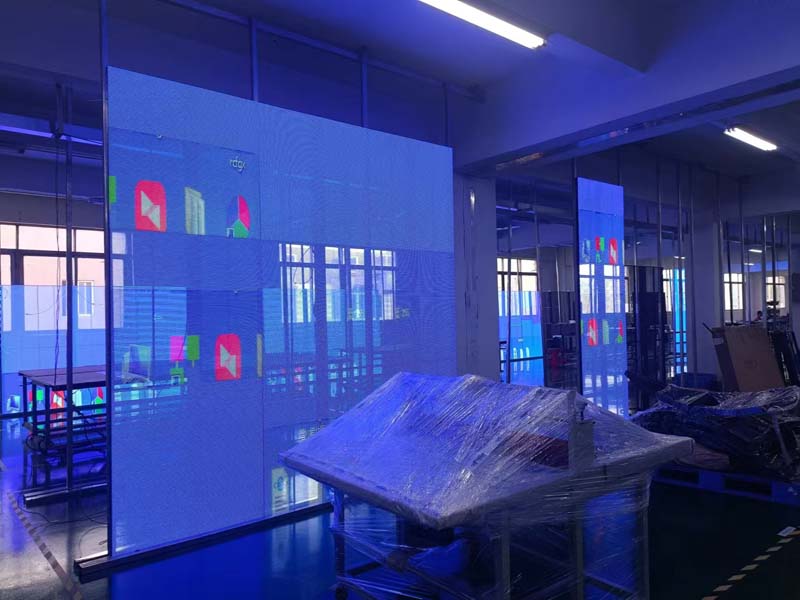
Outdoor LED display modules are the part of a sign that has to survive everything the site throws at it: direct sun, driving rain, salt air, vibration from wind load, and years of thermal cycling between a cold night and a sun-baked afternoon. Most failures that buyers blame on "a bad batch" are actually specification mismatches — a module rated for indoor conditions pushed into a west-facing facade, or a brightness figure quoted at peak that cannot be sustained at midday in summer. This guide walks through the parameters that decide whether an outdoor LED display module lasts eight years or fails in eighteen months, and how to read a supplier datasheet without being misled by it.
Start With the Site, Not the Datasheet
Before comparing pixel pitch or nits, define four things about the installation: the viewing distance range, the ambient light the screen competes with, the climate (rainfall, humidity, salt, temperature swing), and the daily operating hours. A module chosen for a shopping mall entrance in a temperate city is a different product from one facing the sun on a highway gantry in a hot, humid region. Every parameter below should be read against those four site conditions rather than against a generic "outdoor" label.
Pixel Pitch and Viewing Distance
Pixel pitch is the center-to-center distance between LED lamps, expressed in millimeters. It sets resolution per square meter, cost, and the closest distance at which the image still looks smooth rather than pixelated.
As a working rule, the minimum comfortable viewing distance in meters is roughly 1 to 1.5 times the pitch in millimeters for critical viewing, and about 2 to 3 times the pitch for casual viewing. A P10 module is therefore comfortable from around 20 meters for general advertising, while a P4 module suits a closer pedestrian audience.
Pixel pitch (mm) | Typical resolution per sqm | Comfortable viewing distance
P2.5 | ~160,000 px | 5-8 m
P4 | ~62,500 px | 8-12 m
P6 | ~27,800 px | 12-20 m
P8 | ~15,600 px | 16-25 m
P10 | ~10,000 px | 20-35 m
P16 | ~3,900 px | 35-60 m
Do not buy a finer pitch than the audience can resolve. Over-specifying pitch raises cost, heat density and power draw without any visible benefit, and finer pitches are also harder to keep cool in sealed outdoor cabinets.
Brightness: Read the Sustained Figure, Not the Peak
Outdoor modules are commonly specified between 5,000 and 8,000 nits for direct-sun advertising, with 4,500 to 6,000 nits adequate for shaded facades and rental stages. Two numbers matter more than the headline one: the brightness after calibration, and the brightness the module can hold continuously without derating. Ask for both.
Brightness also should not be fixed. A module that runs at full output at night is glaring, wastes power, and shortens LED life. Automatic brightness control via a light sensor, with the ability to run at 60-70 percent of maximum during evening hours, is standard on good outdoor controllers and extends service life noticeably.
Application | Typical brightness target
Sun-facing billboard | 6,000-8,000 nits
Street-level retail facade | 5,000-6,500 nits
Shaded or north-facing wall | 4,000-5,500 nits
Outdoor rental stage | 4,500-6,000 nits
Refresh Rate, Grayscale and Camera Performance
Refresh rate is how many times per second the module redraws. Below roughly 1,920 Hz, cameras and phones capture banding and rolling dark lines, which is a real problem for any screen likely to be filmed — sports venues, event stages, broadcast backdrops. For pure advertising where filming is unlikely, 1,920 Hz is sufficient; for rental and broadcast, specify 3,840 Hz or higher.
Grayscale depth, typically 14 to 16 bit on quality outdoor modules, determines how smoothly the screen renders shadows and dim scenes. This matters more than many buyers expect, because a high-brightness screen with shallow grayscale looks harsh and flat at night, and low-gray performance is where cheap modules are most visibly different.
IP Rating and Water Ingress
The IP rating has two digits: solids first, liquids second. Outdoor modules are usually IP65 on the front face and IP54 or IP65 on the rear. IP65 front protection is the practical minimum for rain-exposed installations; the rear figure matters because moisture enters through cable glands, cabinet seams and maintenance access doors far more often than through the LED face itself.
Front face | IP65 typical for outdoor
Rear / cabinet interior | IP54 to IP65, sealing quality matters more than the digit
Coastal or marine exposure | Additional conformal coating and stainless hardware recommended
Module PCB | Ideally protected against condensation, not just direct spray
For coastal sites, salt fog accelerates corrosion on screws, connectors and cabinet frames long before the LEDs fail. Specify stainless fasteners and treated PCBs, and plan a rinse-and-inspect interval.
Driver IC, Scan Mode and Power
The driver IC controls current to each LED and largely determines grayscale quality, low-brightness uniformity and flicker behavior. Outdoor modules typically use higher-current drivers and scan modes of 1/4, 1/2 or static, which give each LED more on-time and therefore higher brightness than the 1/16 or 1/32 scans common on fine-pitch indoor products.
Power consumption for outdoor modules typically runs 500-900 W per square meter at maximum white, with average consumption in real content around 30-40 percent of that figure. Size the electrical service on the maximum and the operating cost on the average — suppliers who quote only average power for breaker sizing are giving you an incomplete picture.
Thermal Design
Heat is the main aging mechanism for LEDs. A module running 15-20 degrees Celsius cooler can add years to its useful life. Look for aluminum module frames rather than plastic, adequate airflow or forced cooling in the cabinet, and derating behavior in the controller that reduces current when internal temperature climbs. In hot climates, front-to-back cabinet airflow and a light-colored cabinet finish measurably reduce solar heat load.
Selection Checklist
Match pitch to the actual viewing distance band, not the closest possible viewer.
Confirm brightness after calibration and the continuous derating point, not just peak nits.
Require 1,920 Hz minimum refresh, 3,840 Hz for anything filmed.
Verify IP65 front face and inspect rear sealing, glands and door gaskets.
Ask which driver IC is used and what scan mode the module runs.
Request maximum and average power per square meter for electrical design.
Check frame material, PCB protection and fastener grade for the climate.
Ask for a sample module and test it under power for a week before committing to a container order.
HITULED supplies outdoor LED display modules across a range of pitches and brightness classes, and can advise on the specific configuration that fits a given site rather than the largest specification available.
Getting the Module Right the First Time
An outdoor LED display module is a long-term infrastructure decision. The difference between a screen that runs for a decade and one that needs module replacement in year two is rarely the LED brand alone — it is whether pitch, brightness, sealing and thermal behavior were matched to the site. Buyers who specify sustained rather than peak performance, and who treat the rear seal and the driver IC as seriously as the pixel pitch, consistently get more display life per dollar. Contact HITULED for a quotation, a datasheet walkthrough, or a sample module for evaluation against your project conditions.