Buying an outdoor LED billboard for Dubai, Riyadh, Doha or Kuwait City is not the same purchase as buying one for Rotterdam or Chicago. The purchase order may look identical on paper, but the environment the modules will live in is not. Surface temperatures on a south-facing cabinet can climb far above the ambient air temperature, wind-blown sand works its way into every unsealed seam, salt fog eats unbonded aluminum, and a display must still read cleanly at noon in June while running on a local grid that is 230 V at 50 Hz in the UAE and 60 Hz in much of Saudi Arabia. This guide explains how outdoor fixed installation LED display modules should be specified for Middle East advertising, and why each parameter matters.
Why Ambient Heat Redefines the Module Specification
The single most consequential decision in this market is thermal, not visual. LED lamps lose light output as junction temperature rises, and the rate of lumen depreciation accelerates sharply with heat. A module that holds 6,000 nits comfortably in a 25 °C climate will typically deliver noticeably less in a 50 °C enclosure unless the design accounts for it. This is why reputable suppliers derate: they specify brightness at a realistic operating condition, not at a laboratory bench.
Practically, that means a few concrete design choices. Lamp current should be set with thermal headroom rather than pushed to the maximum the driver IC allows, because every increment of current buys brightness at the cost of heat and lifetime. Driver ICs with good thermal packages and constant-current output keep brightness stable as the cabinet heats through the afternoon. The cabinet itself must move air or conduct heat away — die-cast aluminum bodies with finned rear surfaces outperform folded steel, and in enclosed or wall-mounted installations, forced ventilation or air conditioning of the rear service space is often not optional. Power supplies should be loaded to roughly 70–80 percent of rated capacity when the internal cabinet temperature is expected to reach 60 °C or above, since PSU output derates with temperature and a supply running at 100 percent load will fail early in this climate.
Brightness, Contrast and Refresh Rate for Daylight Advertising
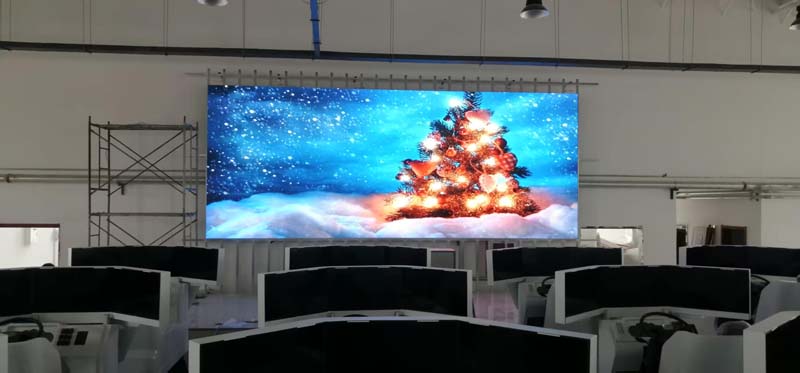
For roadside and building-mount advertising in the Gulf, a working range of 6,000 to 8,000 nits is typical, with 8,000 to 10,000 nits reserved for units facing direct sun with a short viewing window. Higher is not automatically better. Brightness that exceeds what the local authority permits creates light trespass complaints and accelerates aging. What matters more is the contrast structure: a black-faced LED package with a deep mask and a louvered or shingled module surface suppresses reflected sunlight, so the display appears crisp rather than washed out at midday.
Refresh rate matters for two reasons in this region. First, advertising content is frequently filmed or photographed for social media and news coverage; anything below 1,920 Hz will show banding on camera, and 3,840 Hz or higher removes the risk entirely. Second, a high refresh rate combined with 14 to 16 bit grayscale processing lets the display dim smoothly at night through a photocell-driven auto-brightness curve without visible step changes. Nighttime dimming is where cheap modules reveal themselves: at low brightness levels, insufficient grayscale depth produces color banding and a greenish tint that no amount of daytime brightness can compensate for.
Pixel Pitch and Scan Mode for Large-Format Billboards
Pitch selection follows viewing distance, and outdoor advertising is viewed from far away. The rule of thumb of roughly one millimeter of pitch per meter of minimum viewing distance puts a P8 module at about 8 meters, P10 at 10 meters and so on. For a highway billboard viewed from 40 meters and beyond, P10 to P16 is normally sufficient and dramatically cheaper per square meter than a fine-pitch alternative that offers no visible benefit. Unipole and rooftop signs sited close to a slow-moving road may warrant P6 or P8.
Scan mode deserves attention here because it is often hidden in the datasheet. Outdoor modules commonly run 1/4 or 1/8 scan. A static or low-scan design drives each lamp for a larger share of the frame time, which produces higher peak brightness per lamp and better low-gray performance, at the cost of more driver ICs per module. For high-brightness billboard applications where the module will run near its thermal ceiling, the choice between scan modes should be made against measured brightness and heat, not against price alone.
IP Rating, Dust and Coastal Corrosion
In a sandy, coastal environment, ingress protection is the parameter that most directly determines maintenance cost. Front faces should be IP65 at minimum, and IP66 is a reasonable target for modules exposed to wind-driven rain and dust storms. Rear sides need at least IP54, ideally IP65 for full outdoor cabinets. Look for conformal coating on the PCB, gaskets specified in silicone rather than cheap EPDM that hardens and cracks under UV and heat, and pressure-equalization vents that let the cabinet breathe without drawing in dust. In coastal cities, specify C5-M grade corrosion protection on cabinet hardware, screws and mounting brackets; galvanized steel fixings will show rust within a couple of seasons in salt-laden air.
Cabinet Flatness, Calibration and Long-Term Uniformity
A billboard is judged by whether it looks like one continuous image. Module-to-module step tolerance of 0.3 mm or better, achieved through CNC-machined die-cast cabinets rather than welded frames, prevents shadow lines that become obvious at oblique viewing angles. Factory calibration should be delivered as per-module correction data stored on the module itself, so a replacement module inherits the right correction when it is swapped in. Brightness uniformity across a full screen should be in the region of 97 percent or better. Plan on re-calibration with a colorimeter every 12 to 24 months, because LED aging is not perfectly uniform across a large array and drift is more visible on white backgrounds.
Power, Voltage and Local Electrical Practice
The Gulf region is not electrically uniform. The UAE, Qatar, Kuwait, Oman and Bahrain run 230 V at 50 Hz, while Saudi Arabia largely operates at 230 V, 60 Hz. Specify wide-input, auto-ranging power supplies (typically 100–240 V AC, 50/60 Hz) so a single module build serves the whole region and no one installs a 50 Hz-only unit in Riyadh. Power consumption for outdoor modules usually falls in the range of 200–350 W/m² average and 600–900 W/m² peak; size feeders, breakers and any generator backup on peak, and confirm that the local civil defense and municipality requirements for signage circuits, earthing and disconnect placement are met before the module order is finalized.
Maintenance Access
Billboards on rooftops and unipoles often cannot be serviced from behind. Front-service magnetic modules with extractor tools let a technician replace a single module from a lift without opening the cabinet, which in a 45 °C afternoon is the difference between a fifteen-minute job and a two-hour one. Confirm the service regime with the supplier, and hold a spare-parts stock of 3 to 5 percent of installed module count for signs where downtime carries a contractual penalty.
Selection Checklist
Confirm brightness is specified at a realistic high-ambient condition, not a lab figure. Require refresh rate of at least 3,840 Hz and grayscale depth of 14 bit or higher. Match pixel pitch to the actual minimum viewing distance. Verify front IP65 or IP66 with silicone gaskets, PCB conformal coating and C5-M hardware for coastal sites. Check module step tolerance of 0.3 mm and die-cast cabinet construction. Confirm auto-ranging 100–240 V, 50/60 Hz power supplies. Ask for per-module calibration files and a stated uniformity figure. Confirm front-service access if rear access is blocked. Request a thermal test report for the cabinet at rated load.
HITULED builds outdoor fixed installation modules with these conditions in mind, from thermally managed die-cast cabinets to per-module calibration data. If you are specifying a billboard or façade display for the Middle East, contact HITULED for a specification review, a sample module or a project quote.