An outdoor advertising screen is a revenue asset, and the module is the component that decides whether that asset performs for eight years or fails in eighteen months. Buyers who compare only price per square meter usually discover the real cost later: washed-out images at noon, dead pixels after the first rainy season, camera flicker on live broadcast, or a power bill that erodes the margin the screen was supposed to produce. Choosing LED display modules for outdoor advertising screens comes down to matching a small set of electrical and mechanical parameters to the site, the viewing distance, and the content schedule. The sections below explain what each parameter does, how it behaves outdoors, and where the practical thresholds sit.
Start With Viewing Distance, Then Pick Pixel Pitch
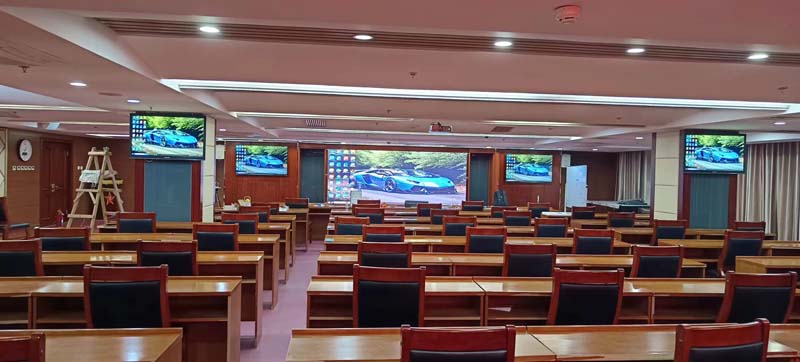
Pixel pitch is the center-to-center distance between adjacent LED lamps, and it sets the minimum distance at which the image stops looking like a grid of dots. For outdoor advertising, a working rule of thumb is that the comfortable viewing distance in meters is roughly one millimeter of pitch per meter, so a P6 module holds up from about six meters and a P10 from about ten meters. Billboards read from vehicles at thirty meters or more rarely justify anything finer than P8 or P10; a P4 module at that distance buys nothing but cost and heat. P2.5 to P4 pitches belong to closer-viewed street furniture, transit shelters, and building facades where pedestrians pass within a few meters.
The trade is not only resolution. As pitch shrinks, lamp density rises, driver IC count rises, and heat per square meter rises with them. A P3 outdoor module in a sealed cabinet in direct sun is a far harder thermal problem than a P10 with the same brightness target. HITULED supplies outdoor modules from roughly P2.5 through P10, and the honest recommendation for most roadside advertising is to buy the coarsest pitch that satisfies the closest realistic viewing distance, then spend the saved budget on brightness consistency, driver quality, and cabinet thermal design.
Brightness and Grayscale: What Outdoor Advertising Actually Demands
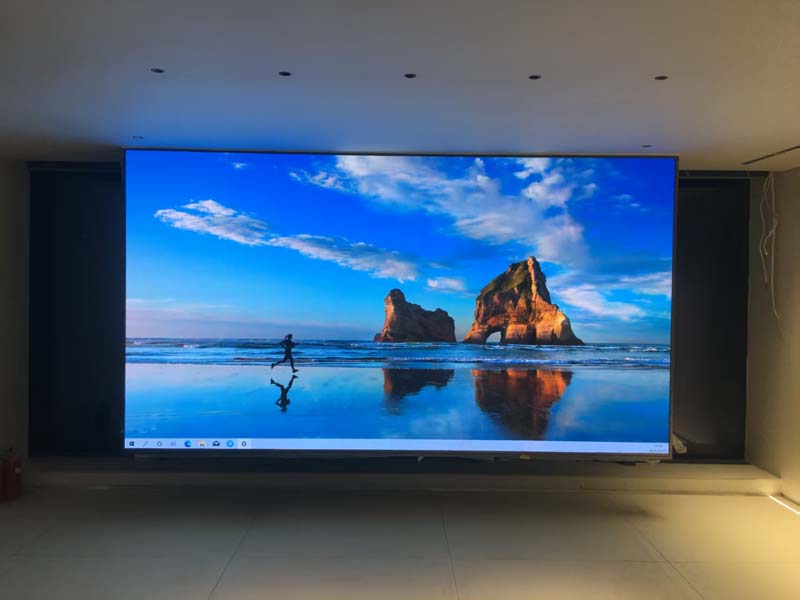
Outdoor screens compete with daylight, so brightness is specified in nits measured at full white. Most roadside and facade advertising runs comfortably at 5,000 to 7,000 nits; screens facing low sun or mounted above reflective surfaces sometimes need 8,000 to 10,000 nits to stay legible. Higher is not automatically better. Every extra nit is current through the lamp, extra heat, and faster lumen depreciation. A 6,500-nit module driven at 70 percent of its maximum rating will typically outlive a 10,000-nit module driven flat out, and it will hold its color far better over time.

Grayscale depth matters more than most buyers expect. Outdoor content is high-contrast: bright sky, dark shadows, glossy product shots. A 14-bit to 16-bit grayscale pipeline keeps shadow detail from collapsing into black blocks and prevents the banding that shows up in gradients across a large screen. Brightness alone will not save a module that crushes low-gray levels, which is why factory calibration of each module batch, with brightness and chroma values written to the module memory, is worth insisting on. Uniformity within a cabinet and from cabinet to cabinet is what separates a professional screen from a patchwork.
IP Rating and Mechanical Build: The Weather Test
The IP rating describes protection against solids and liquids, and outdoors it is the parameter most often overstated in marketing. The front face of an outdoor module is normally IP65 or IP66, meaning dust-tight and resistant to powerful water jets. The rear is the weak point: many modules carry IP54 or IP65 at the back, and the cabinet, gasket, cable entry, and service-door design determine whether water ever reaches it. Ask how the rear cover seals, whether the module uses a screw-fixed or magnetic face, and how the cabinet handles condensation when the interior warms and cools daily. Ventilation with filtered air, or a sealed design with heat exchangers, both work, but they are different maintenance commitments.
Also confirm UV stability of the mask and potting compounds, and the corrosion treatment of the cabinet and fasteners, especially for coastal installs where salt fog attacks steel and connector pins. Galvanized or hot-dip finished steel, stainless fasteners, and conformal coating on driver boards are the practical answers.
Power Consumption and Heat: The Numbers That Recur Monthly
Outdoor modules draw far more than indoor ones because of the brightness requirement. Average power for a P6 to P10 outdoor advertising module typically lands in the 250 to 400 W per square meter range in normal content, with peaks near 700 to 900 W per square meter at full white. Content matters enormously: a bright white advertisement running all day can nearly double the average compared with mixed video. Roughly 60 to 70 percent of the electrical input eventually leaves as heat, which must be removed by airflow or active cooling rather than trapped inside the cabinet.
For a buyer, this means three checks. First, request the module's average and maximum power figures rather than only the maximum. Second, size the power supply with headroom, commonly 20 to 30 percent above the calculated maximum load, so supplies run cooler and last longer. Third, confirm the cabinet's thermal path: aluminum module frames, thermally conductive backing, and airflow that does not recirculate hot air. Under-specced power and heat management is the leading cause of early module failure in outdoor advertising, more than LED lamp quality itself.
Driver IC, Scan Mode and Refresh Rate: Why They Decide Camera Performance
The driver IC controls current to each LED and determines how smoothly the module dims. Outdoor screens are photographed and filmed constantly, for news coverage and for the advertiser's own social content. Refresh rate above roughly 1,920 Hz avoids visible scanning lines on camera; 3,840 Hz is the common professional standard, and higher figures help with high-speed and broadcast cameras. Scan mode, expressed as a fraction such as 1/8 or 1/16, describes how many rows are driven simultaneously. A lower scan number means more driver ICs per module, better brightness reserve, and usually better low-gray performance, at higher cost. For premium outdoor advertising, 1/8 scan at 3,840 Hz is a sound baseline; cheaper 1/16 designs are acceptable for distant billboards where camera work is rare.
Typical Parameter Ranges for Outdoor Advertising Modules
Parameter | Entry-level billboard | Standard roadside | Premium facade/close view
Pixel pitch | P8 to P10 | P5 to P6.67 | P2.5 to P4
Brightness | 5,000 to 6,000 nits | 5,500 to 7,000 nits | 5,000 to 6,500 nits
Refresh rate | 1,920 Hz | 3,840 Hz | 3,840 Hz or higher
Grayscale | 13 to 14 bit | 14 to 16 bit | 16 bit
Front/rear IP | IP65 / IP54 | IP65 / IP65 | IP65 or IP66 / IP65
Average power | 200 to 300 W/m² | 250 to 400 W/m² | 300 to 450 W/m²
Scan mode | 1/8 to 1/16 | 1/8 | 1/8 or finer
Viewing angle | 140° H | 140° to 160° H | 160° H
Cooling | Passive vents | Fan or heat exchanger | Active thermal management
A Practical Buying Checklist
Confirm the closest realistic viewing distance and resist buying finer pitch than it requires.
Ask for average and maximum power figures separately, and check the supply headroom.
Require per-module calibration data and a uniformity commitment across the batch.
Verify both front and rear IP ratings in writing, plus gasket and cable-entry design.
Match refresh rate and scan mode to whether the screen will appear on camera.
Check driver IC brand and lamp brand, since these drive long-term stability more than any other component.
Confirm spare-part availability and module compatibility for the next several years, so a future repair does not require a new batch.
Request a sample module and drive it at your target brightness before committing to a full order.
Conclusion
The right outdoor advertising module is not the finest pitch or the highest nit figure on a datasheet. It is the one whose pitch matches the viewing distance, whose brightness is sustainable rather than maximal, whose sealing and thermal design suit the site, and whose driver electronics keep the image clean on camera. Buyers who evaluate those four things together almost always end up with a lower total cost of ownership than those who shop on price per square meter. HITULED can supply sample outdoor modules with calibration reports so you can verify brightness, uniformity, and refresh behavior under your own test conditions before placing an order; contact our team for a quote, a specification review, or a sample request.